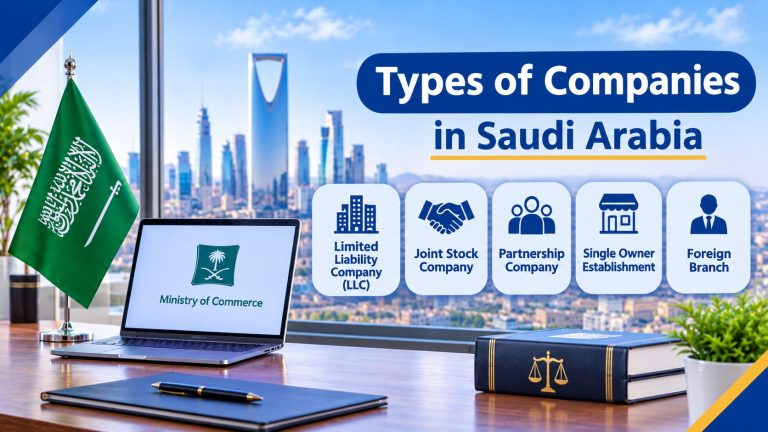
With the accelerating pace of economic growth in the Kingdom under Saudi Vision 2030, company formation in Saudi Arabia has become one of the investment opportunities attracting entrepreneurs and local and foreign investors alike. And one of the most common questions on the minds of those wishing to enter the Saudi market is: How much does it cost to set up a company in Saudi Arabia?
The precise answer is that there is no single fixed figure that applies to all companies; the costs of setting up a company in Saudi Arabia vary depending on the type of legal entity, the business activity, the investor’s nationality, and capital and licensing requirements.
However, the total cost can be estimated accurately once its components and the fees associated with each stage are known. In this guide, we review the most prominent company formation fees, additional and annual costs, along with an estimated model for the first-year budget.
Why do company formation costs in Saudi Arabia differ from one investor to another?
The cost of setting up any company in Saudi Arabia consists of three main groups of expenses:
1. Official government fees
These include fees related to government procedures, such as:
- Trade name reservation fees.
- Commercial registration issuance fees.
- Articles of association or formation contract publication fees.
- Investment registration fees, where applicable.
- Municipal license and activity-specific licensing fees.
2. Professional costs
These are expenses the investor may need to complete the formation procedures, including:
- Notarization of documents and contracts.
- Certified legal translation.
- Engaging a specialized company formation office.
- Legal and accounting consultations.
3. Setup-related operational costs
These include expenses necessary for preparing the company and starting its activity, such as:
- National address registration.
- Renting an office premises.
- Issuing employee residence permits when needed.
- Health insurance.
- Employee-related obligations and social insurance.
The total cost varies from one case to another according to the nature of the activity, the size of the company, and operational requirements — not government fees alone.
First: Government fees for forming a Limited Liability Company in Saudi Arabia
A Limited Liability Company (LLC) is one of the common options for small and medium-sized projects in Saudi Arabia; because it provides an independent legal framework for the company, and limits the partners’ liability for its debts and obligations to the extent of their shares in the capital, according to the provisions of the law.
The following are the fees stated in the estimate for forming an LLC:
| Item | Stated fee (Saudi Riyal) | Notes |
| Trade name reservation | 200 for an Arabic name / 500 for an English name | Reservation is held for up to 60 days, and can be extended for SAR 100 |
| Commercial registration issuance | 1,200 | According to the company type and procedure |
| Articles of association publication (formation contract) | 500 | According to the applicable fees |
| Chamber of Commerce membership | Free for the first 3 years | Fees start from the fourth year according to the class |
| VAT | 15% | Applied according to the nature of the service and the taxable fees |
Based on these figures, the estimated minimum of the stated fees for forming an LLC with an Arabic trade name is around SAR 1,900 before tax, and may reach SAR 2,185 if 15% VAT applies to all the stated items.
Comparison of commercial registration fees across company types
According to the figures stated in the estimate, commercial registration issuance fees differ according to the legal form of the company:
| Company type | Stated CR fee |
| Limited Liability Company | SAR 1,200 |
| Joint-stock company | SAR 1,600 |
| Simplified joint-stock company | SAR 1,600 |
| General partnership company | SAR 1,000 |
| Limited partnership company | SAR 1,000 |
Note: The official fee schedule applicable at the time of formation should be reviewed, as fees may vary according to the service type and government updates.
Second: Cost of setting up a sole proprietorship in Saudi Arabia
A sole proprietorship is one of the lowest-cost options in terms of formation procedures; as it does not require a formation contract like companies, and no minimum capital is required as a general rule.
The basic costs of setting up a sole proprietorship include the following:
- Trade name reservation fees: according to the type of trade name.
- Commercial registration issuance fees: according to the applicable government fees.
- Municipal license: if the activity requires premises or a municipal license.
- Operational costs: such as premises rent and its equipment when needed.
Is a sole proprietorship better than an LLC?
The lower cost of setting up a sole proprietorship does not necessarily mean it is the best choice for every project.
In a sole proprietorship, the owner bears personal liability for the establishment’s financial obligations, whereas an LLC enjoys an independent financial liability, and the partners’ liability in it is limited according to the provisions of the law.
Therefore, it is preferable to choose the legal form based on the nature of the activity and the level of risk — not on the formation cost alone.
Third: Costs of setting up a company for foreign investors in Saudi Arabia
The cost of setting up a company for foreigners in Saudi Arabia differs from that for a local investor; as a foreign investor may need to meet additional requirements related to investment registration, document notarization, and activity requirements.
1. Investment registration with the Ministry of Investment (MISA)
The foreign investor is subject to the requirements of the investment law in force in the Kingdom, which include registering the investment with the Ministry of Investment before practicing the investment, according to the procedures and conditions applicable to the activity.
The financial consideration associated with registration is determined according to what the Ministry decides and the regulations in force at the time of submitting the application.
It is important to note that the old fees associated with the previous licensing system should not be considered fixed current fees; therefore, the financial consideration and applicable procedures must be verified when submitting the application.
2. Capital requirements for trading activities
Some trading activities designated for foreign investors may include special requirements related to capital, ownership percentage, presence in other markets, and investment plans.
According to the figures stated in the estimate, the stated requirements include:
- Trading activity with 100% foreign ownership: capital of no less than SAR 30 million, with presence in at least three regional or global markets, in addition to a binding investment plan.
- Trading activity with a Saudi partner: capital of no less than SAR 26,666,667, with the Saudi partner holding no less than 25%.
By contrast, the Companies Law does not impose a unified minimum capital for an LLC in most service and professional activities, while taking into account any special conditions of the activity or its regulatory authority.
Important: These requirements should not be generalized to all foreign investors or all trading activities; the conditions of the specific activity must be verified with the Ministry of Investment and the relevant authorities before committing capital in the budget.
3. Additional costs for the foreign investor
In addition to government fees, the foreign investor may bear a set of additional costs, the most prominent of which are:
First: Notarization of the parent company’s documents
Formation procedures may require notarizing the parent company’s documents in the country of origin, then completing the required certifications and having them translated by certified legal translation.
This cost is estimated in some cases at around SAR 2,000 to 5,000, according to the country of origin, the number of documents, and the certification procedures.
Second: National address and office premises
The company needs to meet the address and premises requirements according to the nature of the activity and the regulatory conditions.
Premises costs may range from around SAR 20,000 annually for co-working spaces to more than SAR 100,000 annually for commercial offices in cities such as Riyadh and Jeddah.
Third: Expat workforce fees
The costs of employing non-Saudi labor may include the following:
- The financial consideration associated with expat labor, according to the applicable category and regulations.
- Residence permit issuance and renewal fees.
- Dependent fees, where applicable.
- Mandatory health insurance.
- Other obligations related to employment contracts and hiring.
These amounts vary according to the number of employees, their nationalities, the establishment’s status, and the regulations in force.
Fourth: Annual costs after company formation in Saudi Arabia
The investor’s obligations do not end once the commercial registration is issued; there are periodic expenses that must be taken into account when preparing the company’s budget.
The most prominent potential annual costs are as follows:
| Obligation | Estimated annual cost |
| Confirmation of CR data for an LLC | SAR 1,200 |
| Chamber of Commerce membership | SAR 200 – 5,000 depending on the class |
| Municipal license renewal | Determined according to the activity and site area |
| Accounting, financial statements, and audit | According to the size of the activity |
| Zakat, tax, and insurance filings | According to the obligations and the service provider’s fees |
What is the fine for late confirmation of CR data?
The company must comply with the specified deadlines for confirming commercial registration data, and avoid delay in meeting regulatory requirements.
Late confirmation may result in fines or regulatory measures depending on the case, the duration, and the applicable regulations; therefore, it is advisable to follow up on deadlines through the Ministry of Commerce’s official channels.
Fifth: Estimated first-year budget model for a service-sector LLC
To illustrate the picture in a practical way, we present an estimated model for the first-year budget of a service-sector LLC, assuming the presence of some additional expenses specific to the foreign investor.
| Item | Estimated cost (Saudi Riyal) |
| Arabic trade name reservation | 200 |
| Commercial registration issuance | 1,200 |
| Articles of association publication | 500 |
| VAT 15% | 285 |
| Document notarization and translation for the foreign investor | 2,000 – 5,000 |
| National address and office premises | 20,000 – 50,000 |
| Specialized formation office fees (optional) | 5,000 – 20,000 |
| Approximate total | Around SAR 29,000 – 77,000 |
Note: These figures are estimates for planning purposes, and are not a price quotation or a final statement of government fees. The actual cost may vary according to the city, the size of the activity, licensing requirements, and the number of employees, and some items may not apply to all companies.
How to reduce your company formation costs in Saudi Arabia without violating regulations?
You can reduce unnecessary expenses when setting up your company through good planning before starting the procedures. The most important steps are:
1. Choose your business activity precisely
Determining the activity from the start helps you know the licenses, conditions, and required capital, and spares you additional costs resulting from choosing an unsuitable activity.
For the foreign investor, trading activity requirements may differ greatly from service and professional activities.
2. Start with an Arabic trade name
If an Arabic name suits your activity’s identity, it may help you save part of the trade name reservation fees compared to an English name, according to the applicable fees.
3. Complete the procedures electronically
Use the approved government platforms, such as the Ministry of Commerce and the Saudi Business Center, to complete formation procedures, follow up on applications, and reduce delays.
4. Plan for annual obligations from the beginning
Do not focus on formation fees only; include periodic expenses in your budget, such as CR data confirmation, the municipal license, and zakat and tax obligations.
5. Consult a specialist before forming the company
Choosing the legal form and business activity correctly from the start helps avoid future amendments that may require additional fees and time-consuming procedures.
Conclusion
The costs of setting up a company in Saudi Arabia is not a fixed number, but a set of fees and requirements that vary according to the company type, the activity, the investor’s nationality, and the project size. Some formation procedures may start with limited government fees, while other activities require larger capital, licenses, and additional operating expenses.
Therefore, the most important step before setting up your company is preparing a clear budget that includes formation fees, operational costs, and annual obligations, along with choosing the legal form appropriate to the nature of your project.
If you are planning to start your business activity in the Kingdom of Saudi Arabia, the True Link team can help you understand the formation requirements and choose the appropriate legal entity, through its company formation services in Saudi Arabia.
Contact True Link today and start your company formation steps in Saudi Arabia in an organized and professional manner.
Frequently Asked Questions about Company Formation Costs in Saudi Arabia
1. What is the cheapest way to set up a company in Saudi Arabia?
A sole proprietorship is one of the lowest-cost options in terms of formation procedures, followed by the LLC, whose government fees start — according to the stated estimate — at around SAR 1,900 before tax, with the final cost varying by case.
2. Are there annual fees after company formation?
Yes, there are annual or periodic obligations, which may include confirmation of CR data, Chamber of Commerce membership when due, municipal license renewal, in addition to accounting and zakat and tax filings.
3. Do formation costs differ between Saudi and foreign investors?
Yes, some basic fees may be similar, but the foreign investor may bear additional costs related to investment registration, notarization of foreign documents, and the requirements of certain activities.
4. What capital is required to set up a fully foreign-owned trading company?
Capital requirements vary according to the activity and applicable regulations. The estimate cited in this guide mentions SAR 30 million for some trading activities, with additional conditions; however, the applicability of these requirements to the specific activity must be confirmed with the Ministry of Investment before making a decision.
5. Is Chamber of Commerce membership payable from day one?
According to the estimate cited in this article, membership fees are not collected during the first three years, and fees start from the fourth year. The applicable class and fees should be reviewed at the time of registration.